California 2026 ADU Laws: A Central Coast Guide
California's 2026 ADU Laws: What Central Coast Homeowners Need to Know Before They Build
Three new California laws changed the ADU rules in 2026. Most agents will hand you a Zillow link and call it a day. I'm working an active ADU permitting file right now, as a licensed general contractor, so I can tell you what these laws actually do on the ground here in the 805.
Here's the short version. Building an accessory dwelling unit on the Central Coast got faster, cheaper to design, and clearer on paper. But there's a cost nobody puts in a Reel, and it can quietly shrink your budget before you pour a single foundation. More on that below.
What are the new California ADU laws for 2026?
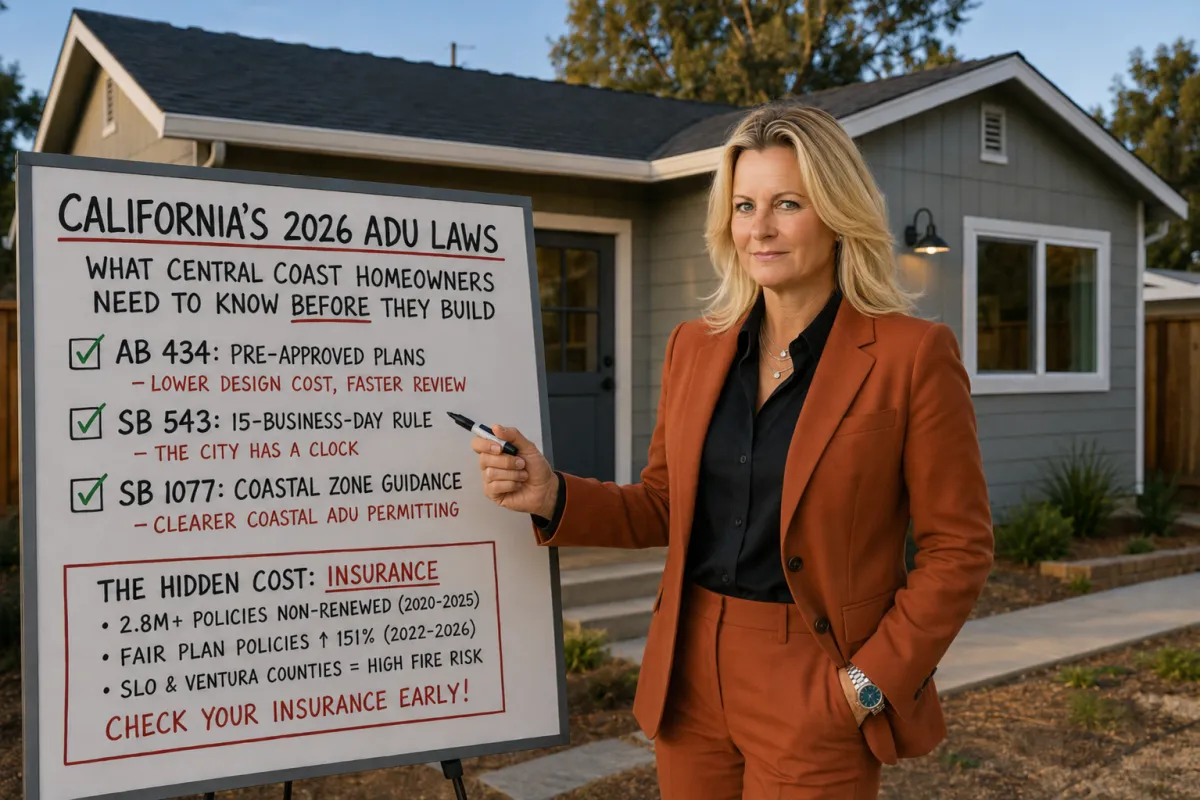
Three bills matter this year. AB 434 requires every city to publish pre-approved ADU plans by January 2026, so you can skip a lot of custom design cost. SB 543 gives permitting agencies a hard 15-business-day deadline to tell you in writing whether your application is complete. And SB 1077 required the California Coastal Commission to publish guidance by July 1, 2026, to simplify ADU permitting in the coastal zone. Together they shorten timelines and reduce the guesswork that used to stall projects for months.
That's the answer most people are searching for. Now let's talk about what it means for your property in Orcutt, Nipomo, or along the coast.
AB 434: Pre-approved plans can save you real money
Design fees are one of the first big checks you write on an ADU. AB 434 changes that math.
Every California city now has to offer pre-approved ADU plans, posted online, ready to use. The city already reviewed those plans for structural integrity, Title 24 energy standards, and state building code. So the internal design is treated as compliant before you even apply. Review focuses on your specific lot instead of the whole set of drawings.
What does that mean for you? Lower design cost and a shorter review window. You still pay plan-check fees, and you still need site-specific work. But you're not starting from a blank page and a $10,000 architect bill.
Here's the truth though. A pre-approved plan is only as good as the lot it sits on. Setbacks, slope, utility connections, and existing structures all change what actually fits. That's where a contractor's eye matters before you commit to a plan number.
SB 543: The city now has a clock
If you've ever felt like a permit office was stalling you, SB 543 is for you.
As of January 1, 2026, the agency has 15 business days to determine whether your application is complete and to tell you in writing. If it's incomplete, they have to give you a written list of every missing item and how to fix each one. When you resubmit, they can only review what they flagged the first time. No new surprise requirements.
And if they miss the deadline? Your application is automatically deemed complete.
Believe it or not, this is a big deal. The old game was death by a thousand deficiency notices. One round of corrections, then another, then another. SB 543 puts a stop to that. It rewards a clean, complete submittal on the first try, which is exactly the kind of prep work that separates a smooth project from a six-month headache.
SB 1077: Coastal zone permitting gets clearer
Own property near the water in Pismo Beach, Grover Beach, Arroyo Grande, or the Nipomo mesa toward the coast? The coastal zone has always been its own animal.
SB 1077 required the Coastal Commission, working with the state housing department, to publish written guidance by July 1, 2026, helping local governments simplify ADU permitting in the coastal zone. The draft went out for public comment in spring 2026, with a workshop in May. The goal is to clear up the local coastal program rules that used to make coastal ADUs slower and less predictable than inland ones.
This is where local experience truly matters. A coastal parcel and an inland parcel can follow two very different paths to the same ADU. Knowing which rules apply to your address is half the battle.
The hidden cost nobody puts in a Reel: insurance
Now the part the highlight videos skip.
You can have the fastest permit in the county and still get squeezed by something that never shows up in a median-price stat: insurance. Major carriers have pulled back hard across fire-prone California. The state reported insurers non-renewed more than 2.8 million homeowner policies between 2020 and 2025 in fire-prone ZIP codes. California FAIR Plan policies jumped 151% between September 2022 and March 2026.
San Luis Obispo and Ventura counties both sit on the state's high fire-risk list, and plenty of Santa Barbara County backcountry qualifies too. Add an ADU to a property in one of those zones and you're insuring more square footage on a policy that's already harder and pricier to place.
Why does that matter for your ADU budget? Two reasons. Higher premiums eat into the rental income or family savings the ADU was supposed to create. And insurance gaps can tighten lender underwriting, which affects your financing before you break ground. The FAIR Plan did raise its maximum dwelling coverage to $3 million in January 2026, which helps higher-value properties, but it's still a coverage of last resort at a real cost.
Here's my advice. Confirm your insurance picture early, before you finalize the ADU plan, not after. A quick call to your carrier about the added structure can save you an ugly surprise at the worst possible moment.
Why work with an agent who's also a contractor
Every agent can send you a link to the new laws. Not every agent has stood on a job site and watched a permit file move through a real city process.
I'm a REALTOR and a licensed general contractor, and I'm managing an active ADU permitting file right now. I see the setback that kills a plan, the deferred maintenance that complicates an add-on, and the insurance question most people don't ask until it's too late. That's the same contractor's eye that's caught a $15,000 foundation problem and hidden roof damage for my clients before they were locked in.
An ADU can add real value and income to your Central Coast property. But only if the plan, the permit, and the numbers all line up. You're always in control of the final decision. My job is to make sure you're making it with the full picture.
Thinking about adding an ADU in Orcutt, Santa Maria, Nipomo, Lompoc, or along the coast? Let's talk before you commit to a plan. I'll walk your property, flag what other agents miss, and give you a clear next step. I bring results that move you forward in the 805.
More Blog Posts:https://move805.com/blogs


